
Most papers with bad news for academia are ignored. Once in a while a paper comes along that is destined to be ignored in its own special way. Last week, a poll found that 38 percent of professors aren’t aware of replication.
Replication is the practice of repeating others’ experiments. In philosophy it’s called intersubjective agreement and, if you think about it, it’s the bedrock of all we know. A few years ago there was a thing called the replication crisis. Many since have claimed this phrase is too harsh, but we’re finding out that it didn’t matter. You could have a conversation about the replication crisis around many professors and they wouldn’t understand the words you’re saying.
The paper is full of bad news:
There isn’t a new cohort of young PhDs who have heard of open science practices at a much higher rate.
Professors were actually 2 points worse at knowing what replication is than researchers in general.
The data was a convenience sample from international reproducibility networks, so the numbers should be on the optimistic side.
The word “replication” is defined under the question. Knowing the concept would have been enough.
The findings also show a dose-dependent response where the dose is incentives. Practices that personally benefit researchers are most known and most used. Open access is very popular and it has come to resemble pay-to-play where public funding is used to pay extraordinary fees to publishers. Preprints are second most popular and they prevent you from getting scooped. The order of prevalence roughly matches the order of personal benefit:
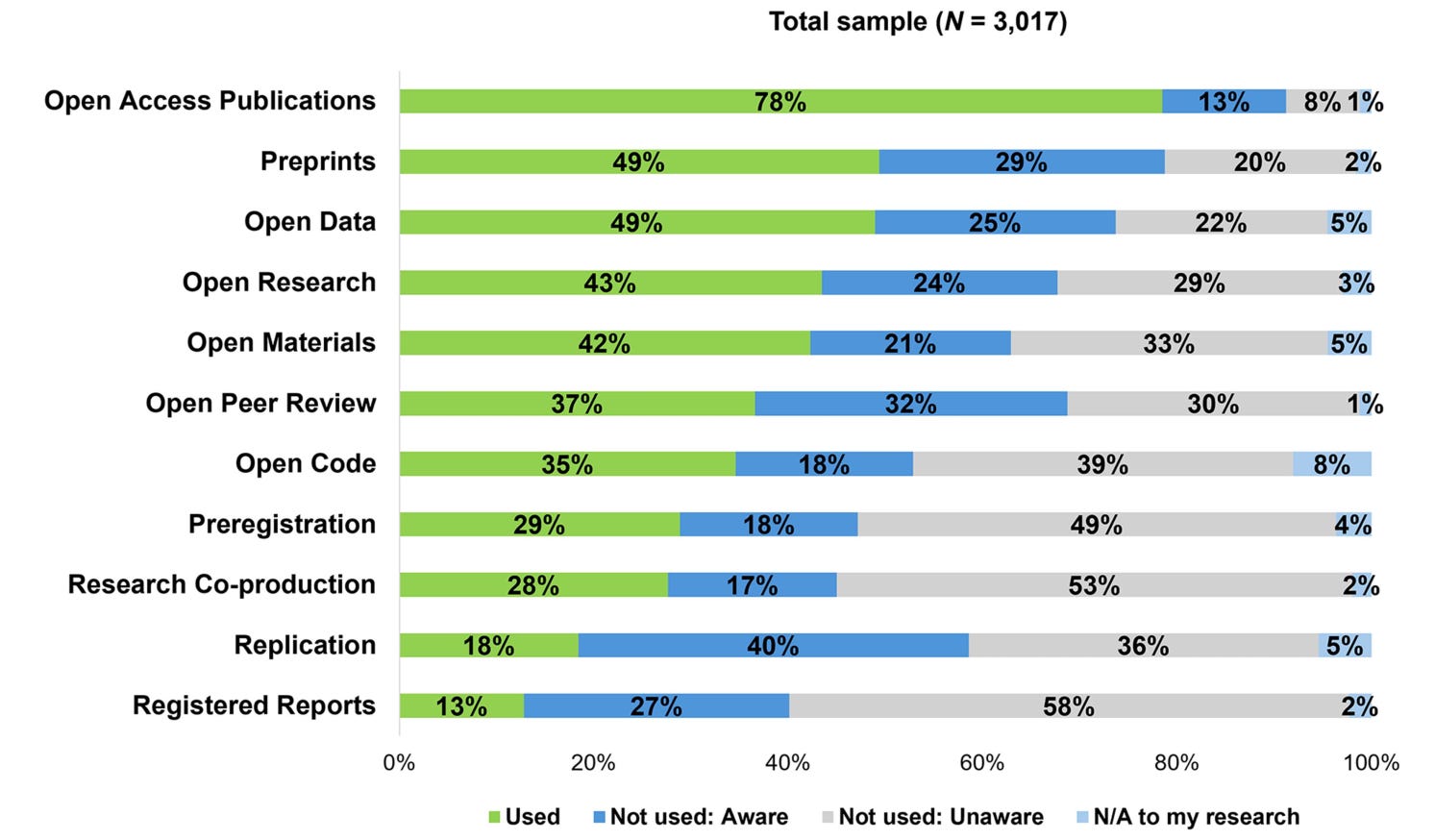
The exception is registered reports at the bottom, a practice that guarantees publication for authors regardless of outcome. Its unpopularity is an ongoing mystery.
This poll, and many results like it, is why the academia-is-actually-okay articles are so frustrating. Someone will find a bad apple and say it’s indicative of all the apples, and the other side will say bad apples are rare.
These views assume science is an apple cart heading in the right direction. An apple falls off, or a lot of apples fall off, so what. In actuality, it benefits researchers more to do worse science. The net direction of the apple cart may be wrong. Public polls suggest it’s true. Peer reviewed results say researchers are made of the same stuff as the rest of us.
We can’t have cheaters prosper. This may sound stark and totalizing, but the next era of the replication crisis should be marked by simplicity. We still need everyone to google the terms.
> This poll, and many results like it, is why the academia-is-actually-okay articles are so frustrating.
That's because those in academia would prefer to believe everything is fine.
Link does not work. Also, it looks like it was just to a figure, but I am not sure. Either way, can you link to the whole paper?