
Last week Google released Deep Review, an AI-generated peer review platform. This sort of thing is right up my street, but that equally may make me biased.
Deep Review is a practical, nondenominational peer review platform that specializes in long, complex documents. Like many Google products, it’s safe, simple, and seemingly unopinionated. If any company is going to capture the risk-averse university and large institution market for AI peer review, it’s probably Google.
I think having a boring, standard paper reviewer is a good thing. Google may bring people to the table on pre-publication and post-publication review.
The flip side is of course the usual dangers of centralization and that users may consider Google Deep Review, or anyone’s AI, the automatic truth. On balance, I’m in favor of making things easier for laypeople and getting more straightforward errors out of science and so a free paper checker backed by a trusted company seems positive. I can’t possibly know how fair or rigorous Deep Review is or will be but so far, so good.
I uploaded two papers that I’d already reviewed publicly that predate the release of Deep Review. Alcott et al., the viral Facebook-deactivation-makes-you-happy paper, and Schwaba et al., the association between genes and personality featured in The New York Times.
Both of these are important papers for the kind of democratization of scientific public opinion that I’m interested in. Insiders and statisticians should have no trouble critiquing and then ignoring these papers, but the public, journalists, and influential twitter personalities may take them at face value. On this, Google Deep Review and other LLM platforms have a chance to do some good and there’s evidence that they will. Both reviews came up with some of the same points I raised. They are points some have wanted science and the public to understand for a long time.
Facebook deactivation
Last year, a working paper achieved over 5 million views thanks to a glowing tweet storm calling deactivating Instagram or Facebook comparable to therapy. I took it up as a chance to do a lesson plan for students learning critical appraisal in April 2025.
Deep Review found 7 major and 23 minor errors in the paper. For the most part, I found the minor errors ignorable, things like spelling or punctuation. However, it called this error minor:
“...the effect is ‘statistically distinguishable from zero ... at the (p=0.14) level,’ before noting in the next sentence that it does not meet the pre-registered (p=0.05) significance threshold.”
My review had this as question number 1 on the quiz. The authors did diverge from their promise to use a p < 0.05 threshold, and there is no “0.14 level.” This is not a minor error because it’s misleading. It’s easy for insiders to pick out, hard for outsiders.
Payments may be the thing making participants happier
This is one of the main problems with the paper. People who were happier also got more money. The effect size is small and therefore could easily be explained by a little extra money. Participants could find $125 more in a week a lot of fun, certainly a little bit. People working for online surveys tend to be that way.
$125 could be a birthday present, a trip to the shore, or a fancy dinner for two. This obvious flaw is not discussed. It’s a major problem, and Deep Review nailed it. It put it in somewhat bland terms, “discussing why a $125 payment differential is unlikely to drive the observed emotional state improvements would bolster the identification argument,” but it performed beautifully.
This confound is not a deep confound. One of the reasons this paper is a good first paper for students is that its flaws are fairly obvious, but boy is this kind of convergence a sight for sore eyes. I highly recommend it with humans or AI.
Another major flaw in the study is its use of subgroup analyses that were not in the preregistration. There are lots of potential subgroups to explore. The paper highlights some findings and not others. Deep Review flagged the statistical flexibility several times and aptly.
I’m sharing Deep Review’s output, and a summary of where I missed something that Deep Review found, and vice versa written by ChatGPT.
I highlighted measurement validity, lack of blinding, and practical significance that Deep Review did not. Deep Review found a lot of issues I missed including a major reporting error where the authors reversed which psychological improvement (15% or 22%) went with which platform.
Unsurprisingly, I use the lens of human motivation more and the LLM almost always sticks to errors that are self-evident and contradictory within the paper, although there’s no reason it can’t do both. Deep Review’s responses are obviously tailored to authors rather than readers. It would be fascinating to see the system prompt, and it would be fascinating to see how a product aimed at consumers of research would differ.
Genes and personality
The headline was “Scientists Find More Than 1,000 Genetic Variants Linked to Personality” and the premise was that we now have the technology to find these kinds of things. (This is false. We now have the power to find something interesting that is inherently buried in billions of false alarms.)
Deep Review found 12 major and 38 minor issues with the paper. It didn’t go deeply into p-hacking and selective reporting, but it did find a multiplicity issue I did not. As before, Deep Review went into much greater detail than I did. Full comparison here.
Worryingly, one of Deep Review’s major findings is wrong:
“In Extended Data Fig. 9, 29 of the 33 reported pairings achieve significance solely through weighted median and weighted mode while MR-CAUSE spans zero (with MR-CAUSE excluding zero in only 4 pairings...”
Almost none of the MR-CAUSE intervals include zero. Interestingly, it missed an actual issue in the same column, two findings in bold indicating significance where the interval did cross zero. This may have been an error in character recognition since the figure was given as an image in the PDF, but Deep Review found the precise opposite of what’s in the table, which may indicate a bad assumption or miscommunication between agents.
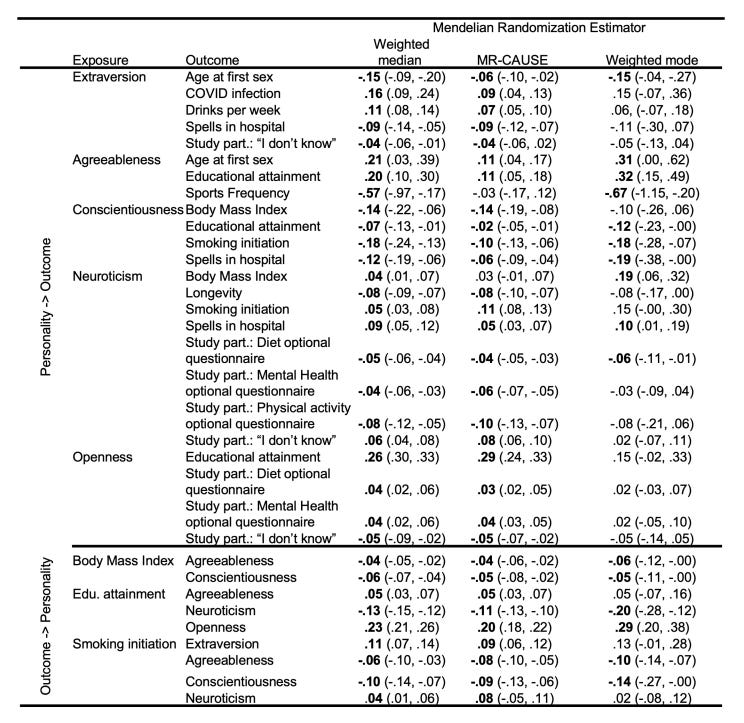
This type of error is more dangerous for critics than authors. Presumably an author would check, or they would be familiar enough with the table not to run with Deep Review’s critique. So this error, while major, is relatively fine.
Now you might say, “You’re letting AI off the hook!” Yes. This table alone has two reversed intervals, an impossible interval, breaks its own inclusion rules, and the entire premise of the paper is false. AI outperformed 138 authors, The New York Times, along with countless readers and commenters.
Overall comments
General-purpose LLMs are starting to do post-publication review competently. A year ago, my experiments with LLM review were much less successful. LLMs needed hand-holding, didn’t know their own limitations, and gave vague hand wavy responses. The fact that they’ve improved substantially is heartening because I think more people need access to this information to make sense of their lives and the world around them. Peer reviewers, journalists, and authors themselves are not doing an adequate job of finding and surfacing fairly obvious and self-evident errors. Well-accepted reforms are being adopted at a glacial pace and may even reverse given the size and interests of primary research.
There are, on the other hand, major concerns with this development. As LLMs start to outstrip humans in certain activities — one of which is the ability to produce giant walls of dense text — our ability to vet them is diminished.
I’ve worked on labeling for AI companies and that concern has certainly arrived. On one job, I concluded that the only way a human could be doing the work thoroughly, reading 10 * 50,000 word outputs in an 8 hour shift is to cheat, pasting the outputs into another LLM, which is strictly prohibited. Humans simply cannot read a half million words of dense technical text in a day and understand whether or not the LLM is, for instance, lying.
The humans training LLMs may be contingent workers hired by a third party labeling company with no interest in the outcome other than getting their tasks approved. In most cases, labelers don’t even know who the client is. In the past, humans could readily identify six-fingered hands all day. Now the work is exhausting.
Deep Review may also be sycophantic towards authors. At up to $20 for a 40 page document, it ought to be. It may avoid critiquing things authors can’t control by the time they’re writing the paper like study design. Market forces may put Google in the “author services” industry, an important role but one rife with conflicts of interest. “Prepare this for Nature editor X” comes to mind.
So although my experience with these tools has only become more positive over the last six months, hurdles remain. Pitting one LLM against another, hand checking, forcing re-evaluation, and trying to maintain one’s own disinterestedness are as useful now as ever. However, there is plenty among the self-evident and easy-to-check results to say that we’re watching history being written. That much is beyond doubt.
Appreciate this balanced take!